Development and Design of a Remote-Controlled Vannamei Shrimp Feeder
DOI:
https://doi.org/10.30595/iject.v1i1.1Keywords:
Shrimp pond, Vannamei shrimp, Load cell, Real-time clock, AC motorAbstract
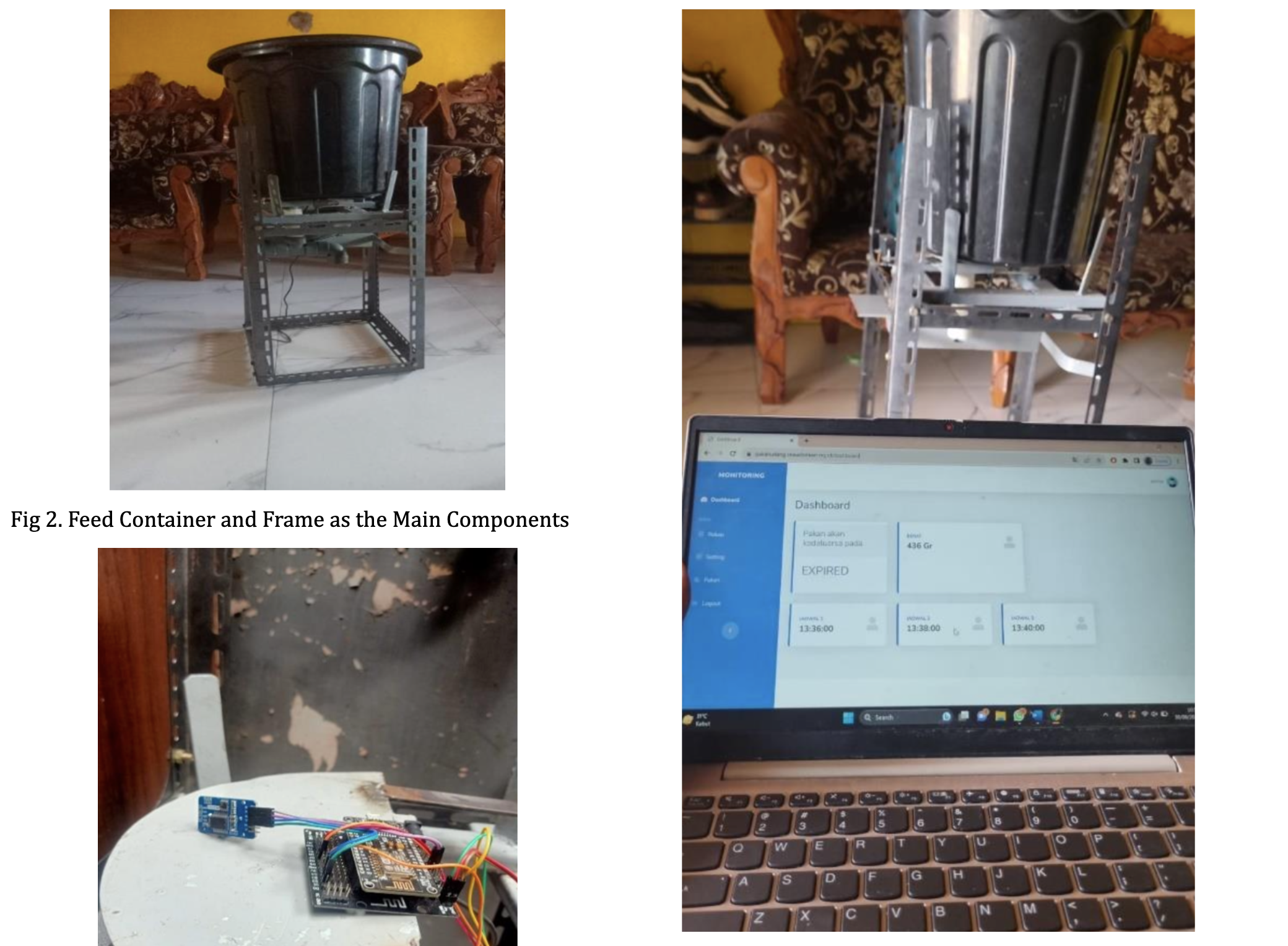
Aquaculture pond water commonly supports multiple aquatic species, including seabass and vannamei shrimp. This study specifically concentrates on vannamei shrimp cultivation in pond systems. Feeding management in shrimp aquaculture constitutes a critical operational parameter, as appropriate feed allocation directly influences growth performance, feed conversion efficiency, and overall production yield. This research involved the design and development of an automatic shrimp feeding system utilizing an HX711 load cell weight sensor integrated with a microcontroller-based control unit. Experimental evaluation demonstrated that the Real-Time Clock (RTC) module exhibited a time deviation of approximately one minute slower than the reference time recorded on a laptop. The implementation of the HX711 load cell sensor in the feed container yielded an average measurement error of 3.1% based on a 350-gram calibration test. The system was capable of dispensing feed with a minimum output resolution of 1 gram. Furthermore, operational data generated by the system are transmitted to a database, visualized through a web-based interface, and accessible for real-time monitoring.
Downloads
References
[1] Miftahul Reski Putra Nasjum, “Rancang bangun kontrol dan monitoring pakan otomatis,” Kaos GL Derg., vol. 8, no. 75, pp. 147–154, 2020, [Online].
[2] Menggunakan Metode Quality Functio Deployment Pada Pt .Esaputlii Prakarsa Utama Kabupaten Tugas Akhir Qayyim 18 Tia 411 Diajukan untuk memenuhi sebagai persyaratan guna menyelesaikan program Diploma Tiga Jurusan / Program Studi,” 2021.
[3] Rahayu deny danar dan alvi furwanti Alwie, A. B. Prasetio, R. Andespa, P. N. Lhokseumawe, and K. Pengantar, “Tugas Akhir Tugas Akhir,” J. Ekon. Vol. 18, Nomor 1 Maret201, vol. 2, no.1, pp. 41–49, 2020.
[4] R. S. Saputri, “Rancang Bangun Alat Pemberi Pakan Udang Vaname (Semi Automatic Feeder ) Berbasis Iot ( Internet of Things ) Bangka Belitung Tahun 2019,” 2019.
[5] F. Asmana, M. Kamal, and A. Finawan, “Rancang Bangun Prototype Sistem Pemberi Pakan Udang Otomatis Berbasis IoT,” J. Tektro, vol. 06, no. 01, 2022.
[6] D. Eridani, E. D. Widianto, and N. Kholid, “Rancang Bangun Sistem Monitoring Dan Controlling Tambak Udang Windu Dengan Konsep Internet Of Things Menggunakan Protokol Message Queuing Telemetry Transport,” CESS (Journal Comput. Eng. Syst. Sci.,vol. 5, no. 1, p. 137, 2020, doi:10.24114/cess.v5i1.14718.
[7] P. Tambak and U. Berbasis, “EINSTEIN ( e-Journal ) Jurnal Hasil Penelitian Bidang Fisika,” 2020
[8] S. Lia, “Rancang Bangun Pakan udang Otomatis,” Jurnal, no. 8.5.2017, pp. 2003–2005, 2022, [Online]. Available: https://www.who.int/news-room/fact-sheets/detail/autism- spectrum-disorders
[9] A. Geofmi Putra, W. M. Faizal, and P. Negeri Bengkalis, “Politeknik Negeri Bengkalis,” 2022.
[10] MIFTAHUL RESKI PUTRA NASJUM, “Rancang bangun pemberi makan udang,” Kaos GL Derg., vol. 8, no. 75, pp. 147–154, 2020,
Downloads
Published
Versions
- 2026-07-21 (2)
- 2026-06-30 (1)
Issue
Section
License
Copyright (c) 2026 Addhil Izzulhaq, Arif Rakhman, Lukmanul Khakim (Author)

This work is licensed under a Creative Commons Attribution 4.0 International License.
Authors who publish with the Indonesian Journal of Electronics and Computer Technology (IJECT) agree to the following terms:
Copyright and First Publication
Authors retain the copyright to their work and grant IJECT the right of first publication. The published work is simultaneously licensed under the Creative Commons Attribution 4.0 International (CC BY 4.0) license, which permits others to share, distribute, reproduce, and adapt the work, provided that appropriate credit is given to the authors and the initial publication in IJECT is properly acknowledged.
Additional Distribution Rights
Authors may enter into separate and additional contractual arrangements for the non-exclusive distribution of the published version of their work, including depositing the article in an institutional repository or publishing it as part of a book, provided that the initial publication in IJECT is properly acknowledged.
Online Self-Archiving
Authors are permitted and encouraged to make their published work available online, including through institutional repositories or personal websites, after publication in IJECT. Any such distribution should include appropriate acknowledgement of the article's initial publication in IJECT.
In summary, authors retain copyright, IJECT receives the right of first publication, and published articles are distributed under the CC BY 4.0 license, allowing reuse and redistribution with appropriate attribution and acknowledgement of the original publication in IJECT.