Design and Development of a Microcontroller-Based Water Usage Monitoring and Control System
DOI:
https://doi.org/10.30595/iject.v1i1.4Keywords:
Water Monitoring, Water Control System, Microcontroller, Internet of Things (IoT), Water Flow SensorAbstract
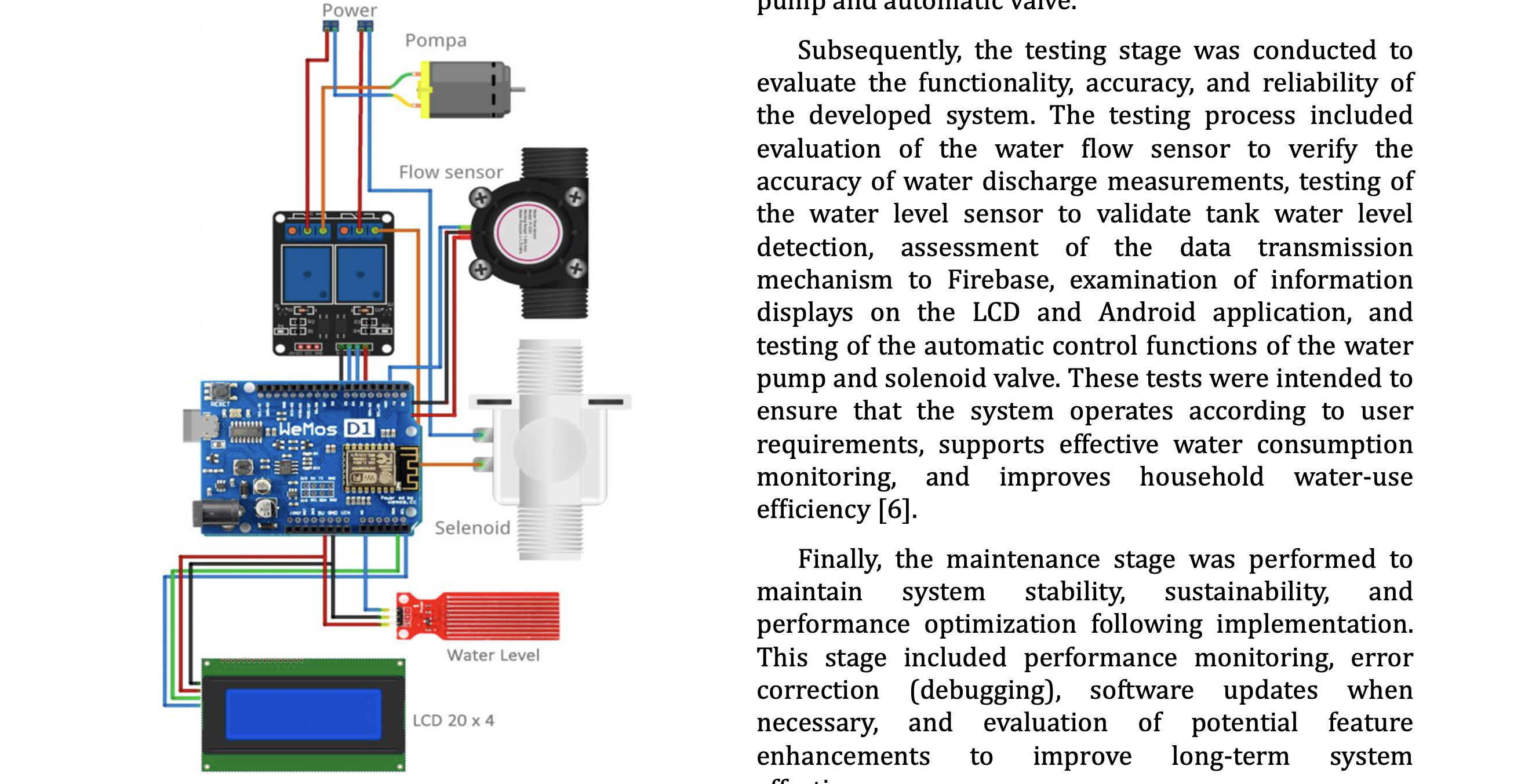
Water is one of the fundamental human necessities that plays a crucial role in supporting daily domestic activities. However, uncontrolled water consumption frequently results in excessive usage and increased household water expenditure. This study aims to design and implement a microcontroller-based water usage monitoring and control system to improve water-use efficiency and facilitate real-time monitoring. The proposed system utilizes the Wemos D1 R1 as the primary microcontroller integrated with a water flow sensor to detect water discharge, a water level sensor to monitor water levels in the storage tank, relays, a water pump, a solenoid valve, an LCD 20x4 display, and Firebase database integration for Android-based data communication and monitoring. The research methodology consists of analysis, design, testing, implementation, and maintenance stages. The implementation results demonstrate that the system is capable of monitoring water usage discharge, displaying water level information, and performing automatic control of the water filling process in the storage tank. The developed system is expected to improve household water-use efficiency and assist users in controlling water consumption more effectively and systematically.
Downloads
References
[1] Referensi terkait pengelolaan sumber daya air dan monitoring penggunaan air.
[2] Pauzan et al. (2022). Rancang Bangun Sistem Kontrol Watermeter PDAM Berbasis IoT.
[3] Lumembang et al. (2021). Rancang Bangun Sistem Penghemat Air pada Rumah Kost berbasis Internet of Things (IoT).
[4] Vambudi et al. (2022). Rancang Bangun Sistem dan Kontrol Penggunaan Air PDAM Secara Realtime Berbasis Wemos dan IoT.
[5] Literatur perangkat Wemos D1 R1, Water Flow Sensor, Relay, Solenoid Valve, Arduino IDE, dan Firebase.
[6] B. T. PERSADA, ‘water level sensor’, 2019. https://bilangteknopersada.co.id/water-level-sensor/
[7] Normah, B. Rifai, S. Vambudi, R. Maulana, ‘Rancang Bangun Sistem dan Kontrol Penggunaan Air PDAM Secara Realtime Berbasis Wemos dan IoT’, J. Tek. Komput. AMIK BSI, 174–180, 2022.
[8] A. Faudin, ‘Tutorial Cara Mengakses Wemos D1 R1 ESP8266 versi Uno’, 2020. https://www.nyebarilmu.com/tutorial-cara-mengakses-wemos-d1-r1-esp8266-versi-uno/
[9] ‘Difinisi flowmeter dan jenis flow meter serta cara instalasi’, 2016.
[10] L. Rahmadhani, ‘sensor water flow’, stodocu, 2020. https://www.studocu.com/id/document/universitas-andalas/sistem-tertanam-1/kelompok-4-laporan-sensor-water-flow/44945815
Downloads
Published
Issue
Section
License
Copyright (c) 2026 Aulia Muhandas Prawoto (Author)

This work is licensed under a Creative Commons Attribution 4.0 International License.
Authors who publish with the Indonesian Journal of Electronics and Computer Technology (IJECT) agree to the following terms:
Copyright and First Publication
Authors retain the copyright to their work and grant IJECT the right of first publication. The published work is simultaneously licensed under the Creative Commons Attribution 4.0 International (CC BY 4.0) license, which permits others to share, distribute, reproduce, and adapt the work, provided that appropriate credit is given to the authors and the initial publication in IJECT is properly acknowledged.
Additional Distribution Rights
Authors may enter into separate and additional contractual arrangements for the non-exclusive distribution of the published version of their work, including depositing the article in an institutional repository or publishing it as part of a book, provided that the initial publication in IJECT is properly acknowledged.
Online Self-Archiving
Authors are permitted and encouraged to make their published work available online, including through institutional repositories or personal websites, after publication in IJECT. Any such distribution should include appropriate acknowledgement of the article's initial publication in IJECT.
In summary, authors retain copyright, IJECT receives the right of first publication, and published articles are distributed under the CC BY 4.0 license, allowing reuse and redistribution with appropriate attribution and acknowledgement of the original publication in IJECT.