Design and Implementation of a Microcontroller-Based Automatic Floor Mopping Robot
DOI:
https://doi.org/10.30595/iject.v1i1.5Keywords:
ESP32, Ultrasonic Sensor, DC Motor, Water Pump, Automatic Floor Mapping RobotAbstract
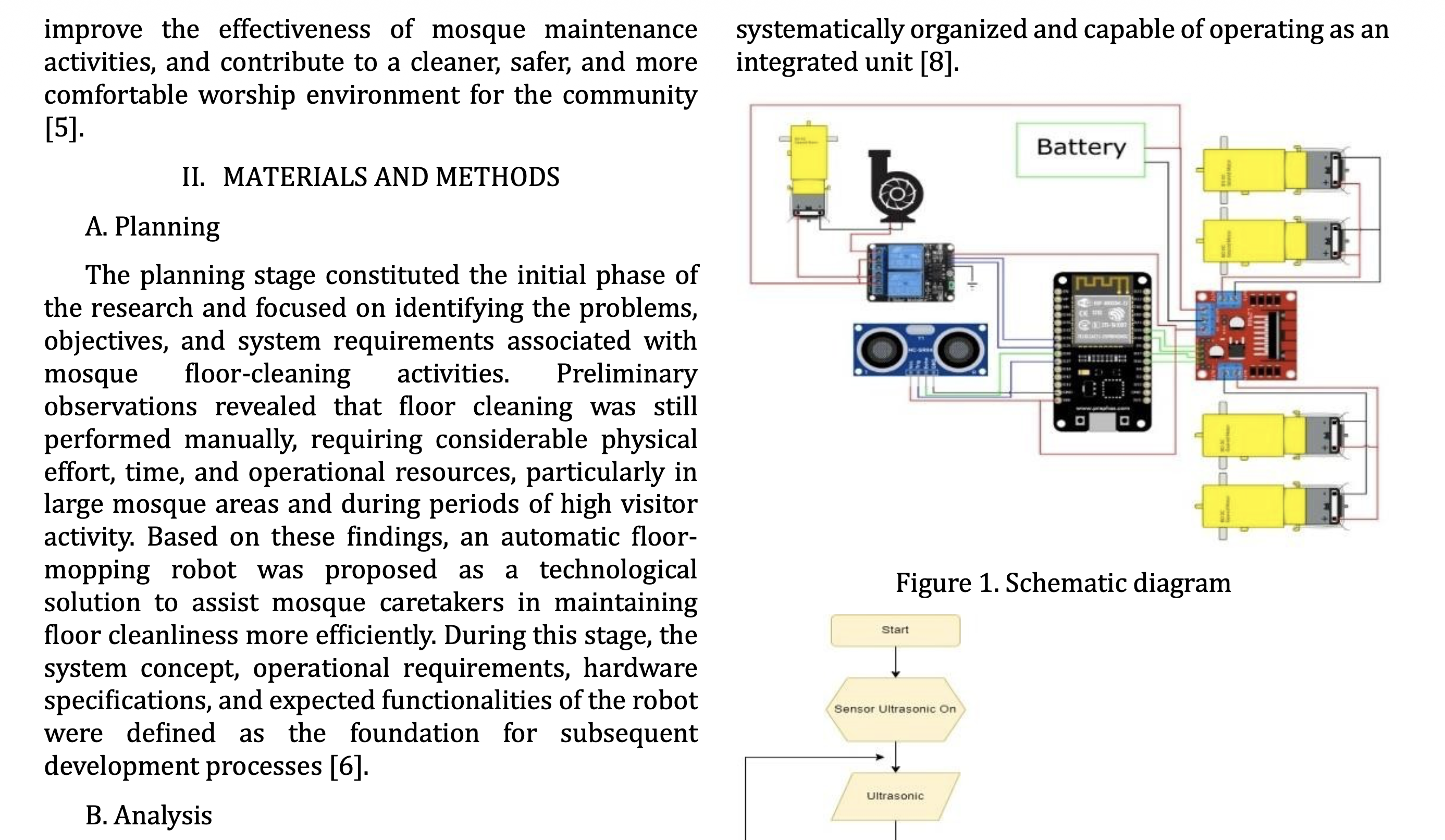
The development of an automatic floor-cleaning robot provides an innovative solution for addressing water puddles that frequently accumulate after rainfall. Although such puddles may appear insignificant, they can pose serious safety risks by increasing the likelihood of slip-and-fall accidents, particularly in public facilities such as mosques. This study presents the design and implementation of an ESP32-based automatic floor mopping robot intended to assist mosque caretakers (marbot) in maintaining floor cleanliness more efficiently and with reduced physical effort. The system was developed using the Software Development Life Cycle methodology with the Waterfall model, which consists of four sequential stages: planning, analysis, design, and implementation. The proposed robot integrates hardware and software components to perform automated floor-cleaning operations and can be controlled through a mobile application. System testing was conducted to evaluate functionality, reliability, and operational performance, as well as to verify that the developed system operated without significant errors and fulfilled the intended design objectives. The testing results demonstrated that the robot was capable of effectively mopping mosque floors, reducing the workload of mosque caretakers, and providing a practical and efficient cleaning solution. Consequently, the proposed system has the potential to improve both cleanliness management and user safety within mosque environments.
Downloads
References
[1] S. . F. H. Lianarti , Oslan Jumadi, “Lianarti , Oslan Jumadi , St . Fatmah Hiola,” 2015.
[2] M. Mediawan, “Sistem Penyiram Tanaman Otomatis Berbasis Arduino Pada Rumah Tanaman,” NASPA J., vol. 42, no. 4, p. 1, 2005.
[3] A. Cahyono, “Rancang Bangun Sistem Kontrol Penyiram Tanaman Berdasarkan Sensor Soil Moisture Dengan Menggunakan Arduino,” Explor. IT J. Keilmuan dan Apl. Tek. Inform., vol. 11, no. 1, pp. 7–12, 2019, doi:10.35891/explorit.v11i1.1469.
[4] J. Tarigan and M. Bukit, “Rancang Bangun Sistem Penyiraman Tanaman Secara Mandiri Berbasis Mikrokontroller Atmega 8535,” J. Fis. Fis. Sains dan Apl., vol. 3, no. 3, pp. 137–141, 2018, doi: 10.35508/fisa.v3i3.615.
[5] S. A. Pratama, “Rancang Bangun Penyiraman Air Otomatis dan Proteksi Hama Tanaman Menggunakan Fuzzy Logic Control,” 2018.
[6] S. ade sudrajat Bahri, “Rancang Bangun Prototype Sistem,” Ranc. Bangun Prototype Sist., vol. 4, no. May, pp. 14–20, 2017.
[7] S. Muharom, H. Suseno, and A. Setyawan, “Rancang Bangun Sistem Penyiram Tanaman Bawang Merah Secara Otomatis,” Semin. Nas. Sains dan Teknol. Terap. VII, pp. 385–390, 2019.
[8] A. Armanto, “Rancang Bangun Penyiram Tanaman Otomatis Menggunakan Sesor Kelembaban Tanah Berbasis Arduino,” J. Teknol. Inf.Mura, vol. 11, no. 02, pp. 76–83, 2019, doi: 10.32767/jti.v11i02.626.
[9] L Khakim, A.H. Sulasmoro, and I Afriliana, “Alat Peringatan Volume Septic Tank dan Netralisasi Kadar Sewer Gas Berbasis Mikrokontroler dan Teknologi Panel Surya”, Komputika: Jurnal Sistem Komputer, vol.12, no.1, pp.35-42, 2023. Doi:10.34010/komputika.v12i1.7538
[10] F. Marinus, B. Yulianti, and M. Haryanti, “Rancang Bangun Sistem Penyiraman Tanaman Berdasarkan Waktu Menggunakan Rtc Berbasis Arduino Uno Pada Tanaman Tomat,” J. Univ. Suryadarma, pp. 78–89,2020.
[11] E. Sakti, “Mikro WiFi,” pp. 3–11, 2013.
[12] I. D. Ardiansyah, A. Setiyadi, “Media Ternak Budidaya Cacing Tanah Berbasis Internet Of Things (IoT) Teknik Informatika – Universitas Komputer Indonesia,” Informatika, vol. 3, no. 2, pp. 34–56, 2019.
[13] Y. A. N. Sadewa and Suseno, “Sistem Pendeteksi Remove Before Flight Tag Menggunakan Radio Frequency Identification ( Rfid ),” no. September,pp. 1–7, 2018.
[14] R. M. KARMANI, “Penerapan Kurikulum 2013 Pada Program Keahlian Teknik Elektronika Industri Di Smk N 2 Purwokerto,” e-conversion -Propos. a Clust. Excell., 2018.
[15] C. V. Damayanti, “Rancang Bangun Sistem Pengunci Loker Otomatis Dengan Kendali Akses Menggunakan Rfid,” Politek. Negeri Sriwij., vol. 1,no. 1, pp. 33–41, 2017.
[16] B. Priono and D. Satyani, “Penggunaan Berbagai Jenis Filter Untuk Pemeliharaan Ikan Hias Air Tawar Di Akuarium,” Media Akuakultur, vol.7, no. 2, p. 76, 2012, doi: 10.15578/ma.7.2.2012.76-83.
[17] C. D. N. Tulle, “Monitoring Volume Cairan Dalam Tabung (Drum Silinder) dengan Sensor Ultrasonik Berbasis WEB,” pp. 3–9, 2017.
Downloads
Published
Issue
Section
License
Copyright (c) 2026 Elbiem Kusuma (Author)

This work is licensed under a Creative Commons Attribution 4.0 International License.
Authors who publish with the Indonesian Journal of Electronics and Computer Technology (IJECT) agree to the following terms:
Copyright and First Publication
Authors retain the copyright to their work and grant IJECT the right of first publication. The published work is simultaneously licensed under the Creative Commons Attribution 4.0 International (CC BY 4.0) license, which permits others to share, distribute, reproduce, and adapt the work, provided that appropriate credit is given to the authors and the initial publication in IJECT is properly acknowledged.
Additional Distribution Rights
Authors may enter into separate and additional contractual arrangements for the non-exclusive distribution of the published version of their work, including depositing the article in an institutional repository or publishing it as part of a book, provided that the initial publication in IJECT is properly acknowledged.
Online Self-Archiving
Authors are permitted and encouraged to make their published work available online, including through institutional repositories or personal websites, after publication in IJECT. Any such distribution should include appropriate acknowledgement of the article's initial publication in IJECT.
In summary, authors retain copyright, IJECT receives the right of first publication, and published articles are distributed under the CC BY 4.0 license, allowing reuse and redistribution with appropriate attribution and acknowledgement of the original publication in IJECT.